
JAANA KOKKO: WRITTEN SOURCES, ORAL TRADITIONS
- 08.10.2026 kl. 18.00—20.00
- 09.10.2026–11.10.2026 kl. 12.00—18.00
- 14.10.2026–18.10.2026 kl. 12.00—18.00
- 21.10.2026–25.10.2026 kl. 12.00—18.00
- 28.10.2026–01.11.2026 kl. 12.00—18.00
- 04.11.2026–08.11.2026 kl. 12.00—18.00
- 11.11.2026–15.11.2026 kl. 12.00—18.00
- 18.11.2026–22.11.2026 kl. 12.00—20.00
- 25.11.2026–29.11.2026 kl. 12.00—18.00
Critical Gallery, Fire brigade, door C4
Organiser: Critical Gallery
Tags: geopolitics, border studies, women’s work, seasonal work, mobile work, matrilineality, Eastern Finland, Karelian traditions, Baltic Roma, historical materialism.
In recent years, I have sought to capture the essence of a place — most often through experimental and documentary-style moving images. I walk around, settle in a spot for a while, gather observations, take note, come to an understanding, negotiate with my subject, and film and record audio. I return to the place, often and many times. When the images and sounds finally fall into place, everything in them becomes material — including profound encounters. Most of the material never makes it into an exhibition but remains as is. An image must be selected when it offers something other than what is already there.
At a place, I’m first drawn to its geographical features — the landscape, the trees, and the water — but soon I turn to literary sources to map out the place. Events recorded long ago shed light on the place’s past character, offer perspective, and lend depth to time. Sometimes literature comes first, and it mentions a place that I later seek out. More interesting to me than written information, however, is what is here and now — what and who are alive, made of flesh and bone or plant matter, breathing and speaking — and appear alongside that unearthed history, alongside the dead.
Different perspectives and the currents of history intersect at a certain point, which we ultimately call a place, a plot of land, a village, a city — and ultimately, a country. A place has many faces, and they are constantly changing. These shifting identities of a place, the written and spoken words, and the photographer’s relationship with the place, lead to several lines of thought that resonate simultaneously. I follow perspectives that are either simultaneous or sequential, and I do not strive to create a complete, uniform picture from the material, as a biographer or a pure documentarian might do. I suppose I imagine that, in this way, life appears more like itself in the artwork: incomplete, imperfect, multifaceted, and always a work in progress, moving through different strata of time.
In terms of time, this wandering from place to place, these experiences, encounters, and arrangements, take years. My working method is so slow that I’d change it in a heartbeat if I could. Every time a piece is finished, I tell myself that this was the last time.
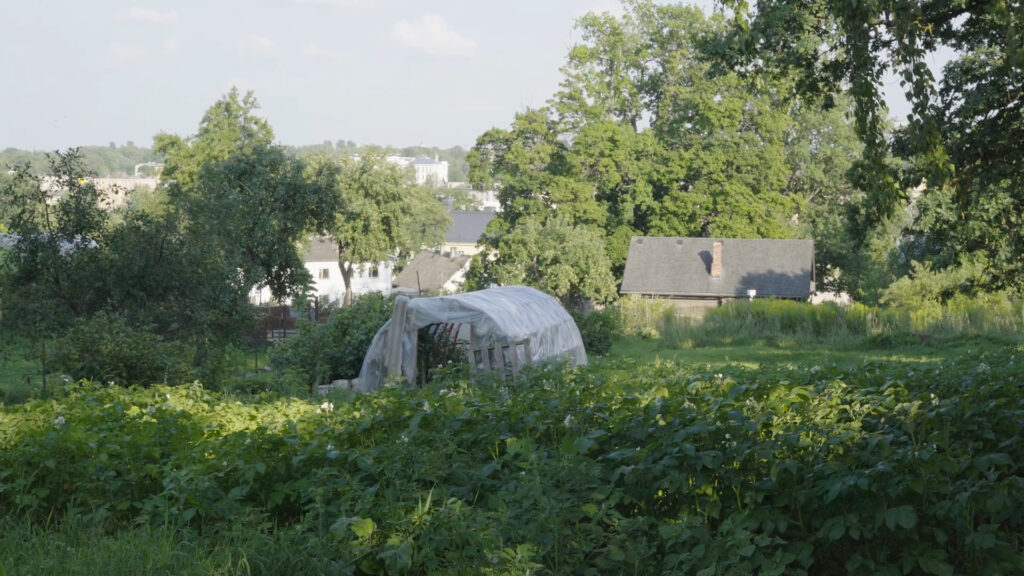
The exhibition at Critical Gallery consists specifically of two such “method films”, which I have been producing in parallel for nine years across two different geographical borders. Roma Mountain / Romanivuori (2022, 38 min) was filmed in a city divided by the Estonian-Latvian border between 2017 and 2022. The international border splits the city into the parts of Valga and Valka. When I first visited Valga, I recognized Hella Wuolijoki (1886–1954), a Finnish-Estonian playwright and politician, in a photograph hanging on the wall of the city museum. After returning home, I read her memoirs, in which she describes the garden of her family’s house in Valga and her experiences following the first Russian Revolution (1905) in 1906. These experiences, combined with the Marxist literature available at the time, had an emancipatory influence on the author. “What kind of garden could lead to political awakening?” I asked. And what do we see when we look beyond what we considered central — when we look at the margins and edges, the imperfections? Ultimately, other histories are found in the garden: the largely overlooked genocide of the Baltic Roma and the itinerant labor of a Roma woman.
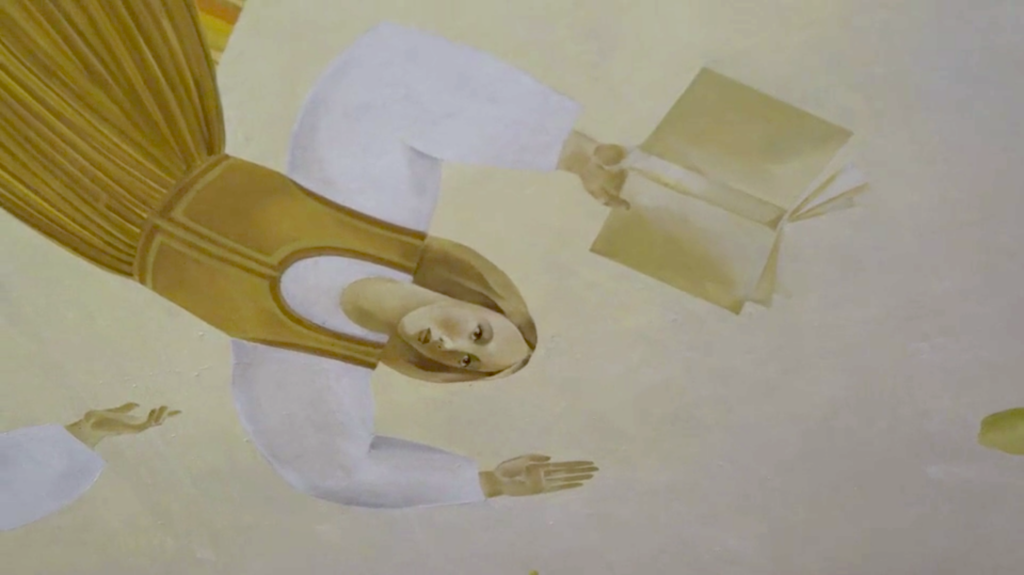
Itä / East (2025, 29:30 min) was filmed in Central Karelia, on the eastern border of Finland, between 2019 and 2024. My mother’s family has lived on a farm in the small village of Potoskavaara since the 18th century. Elias Lönnrot (1802–1884) visited Potoskavaara on his first poetry-collecting expedition in 1828 and wrote a description of a Karelian wedding in his diary. When I visited the courtyard where the wedding took place in the summer of 2019, I encountered Ukrainian seasonal workers. My goddaughter celebrated her wedding at the village hall in 2022. In the film, places, customs, and traditions, laughter and longing, as well as the past and present division of labor, lined up as material that is intertwined, overlapping, and side by side.
The exhibition also features Tapestry (2015–2026), which likewise explores memory and labor as embedded in material. In it, local and global migratory labor, together with personal and emotional lived experience, are woven into the same fabric. The velvets and sequins come from the Kreutzberg textile market; the shirts, their fabrics, and the sewing come from various parts of the world; and the wearing of the garments and their crafting are connected to (my own) matrilineal line.
In Helsinki, 17 September 2026
JAANA KOKKO
1972–
www.jaanakokko.com
“I am an artist, film maker, teacher and occational curator living in Helsinki, Finland. I was born in Joensuu. I am parent of one child (b. 2009).”
Opening on 8 October 2026, 6–8 pm.
CRITICAL CLUB IN NOVEMBER: JAANA KOKKO
Critical Club, Thursday 12 November, 5–7 pm. Jaana Kokko will be in conversation with Teemu Mäki about her exhibition and its themes. You are most welcome!