
SIIRI HAARLA — PRIMAL SCENE
- 25.06.2026 kl. 18.00—20.00
- 26.06.2026–28.06.2026 kl. 12.00—18.00
- 01.07.2026–05.07.2026 kl. 12.00—18.00
- 08.07.2026–12.07.2026 kl. 12.00—18.00
- 15.07.2026–19.07.2026 kl. 12.00—18.00
- 22.07.2026–26.07.2026 kl. 12.00—18.00
- 29.07.2026–02.08.2026 kl. 12.00—18.00
- 05.08.2026–09.08.2026 kl. 12.00—18.00
Critical Gallery, Fire brigade, door C4
Organiser: Critical Gallery
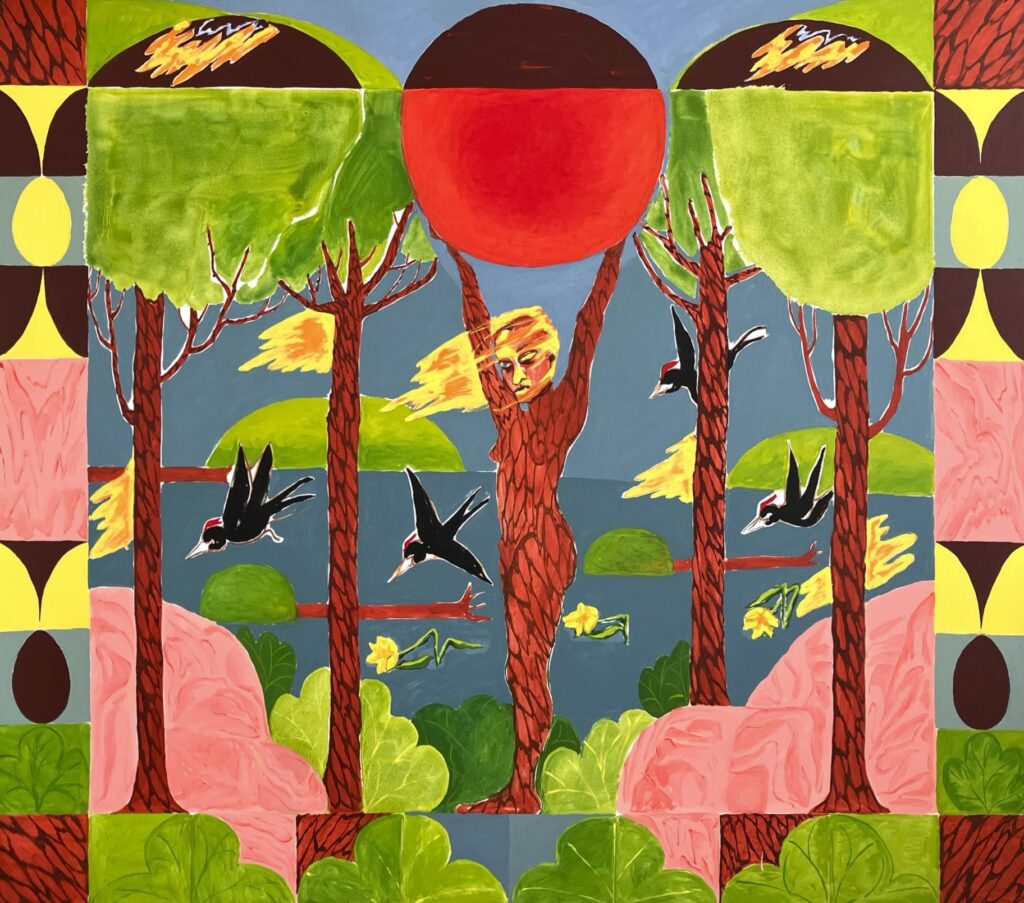
Where and in what does something begin, and why? What if that something is a painting? Where does a painting come from? Why does one painting come into being, and not another?
Art has been thought to have a historical birthplace, and the development of art to consist of variations on a primordial form shaped there. Yet for every beginning, a background can be found. And yet, at some point, somewhere, art began to be art.
Living beings are born or germinate from a seed, and a beginning is marked for their individual existence. When a seed germinates in the ground or in the womb, it has already existed for a long time as a seed that was part of its predecessors. The beginning is conventional and artificial. In their philosophical studies of nature, Goethe searched for the primordial form of plant life and envisioned the idea of the primal plant (Urpflanze). The primal plant is the idea of the plant, of which all existing plants are replicas. Goethe compares the primal plant and plant morphology to the development of art: works of ancient art are the primal plants of art.
Sigmund Freud’s concept of Urszene can be translated into Finnish as kantanäky or alkunäyttämö (primal vision / primal scene). In Freud’s psychoanalysis, the primal vision is the original image of personality and neuroses, to which later symptoms return, refer, and reinterpret. Alkunäyttämögives the concept of Urszene the character of a place, not merely an event. The primal scene is a space in which the self begins to emerge. The primal vision to which Freud originally refers does not need to be historically real. The vision may be an illusion or a delusion; this belongs to the nature of a vision. The primal scene is a paradox: on the stage nothing begins, but rather repeats. The stage is the site of fiction; anything can happen there. The stage produces the play. The two Finnish translations complement one another, yet still leave between them an unresolved rift. In that rift, a solution opens up—a view into the irresolvability of origin.
The colors, forms, materials, and motifs of the paintings have been composed on the canvases as an attempt to return to the original, to dredge a fossil or a wreck from the mud at the bottom of an inland sea. Painting has been a kind of shamanistic roulette, with no guarantees of success or survival. There are hopelessly too many images, meanings, and emotions for any kind of marking or interpretation. The situation is difficult; I have discovered this—certainly true.
The exhibition is part of my doctoral dissertation at the Academy of Fine Arts, University of the Arts Helsinki.
Primal Scene is the third and final artistic component of my dissertation.
– Siiri Haarla
—
Siiri Haarla (b. 1986) lives and works in Helsinki and Berlin.
Central to Haarla’s paintings are the meanings of color, vision, corporeality, and the formation of selfhood. Through her art, Haarla seeks to depict the human condition in the world while also foregrounding social and ethical questions. “My paintings are a kind of visual essays—attempts to grasp and depict a phenomenon that has no form prior to that attempt.”
Haarla has recently held solo exhibitions at Forum Box in Helsinki, Gallery Saskia in Tampere, and Toolbox Gallery in Berlin, and has participated in group exhibitions in Finland and internationally. Their works are included in the collections of, among others, Kiasma, HAM Helsinki Art Museum, and the State Art Commission. Haarla’s paintings can also be seen throughout the summer at the Sara Hildén Art Museum as part of the Vastamaalattua exhibition.
Alongside her artistic practice, Siiri Haarla currently serves as Professor of Painting at the Academy of Fine Arts, University of the Arts Helsinki, and as Chair of the Board of the Finnish Painters’ Union.